



Rotary Dryers
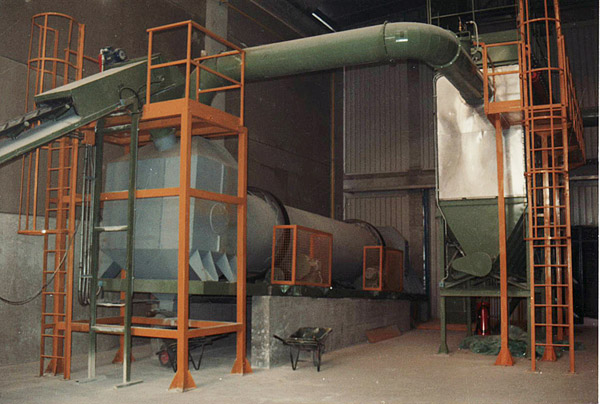
The rotary dryer is one of the most used in the industrial processes.
It’ s simply way of operation, the low maintenance cost, the possibility to
achieve large throughput make it often preferred to other more perfect types.
Typical applications: drying of minerals in general, sand, clays, kaolin,
limestone, metal shavings, fertilizers, various chemical products, bentonite,
gypsum, sewage sludge’s, bones, leather manufacturing wastes. The rotary
dryer may be designed in various arrangements, according to the features of
the material to be treated. First of all the drying process may be
carried out ίn COUNTERFLOW or PARALLEL FLOW. ln the first case, the hot
gases meet the material near the discharge outlet of the dryer.
This solution enables, to achieve high drying degrees and adequate when
the material may with¬ stand high temperatures without any alterιnation.
The drying in parallel flow is instead preferable for heat-sensitive materials or
for materials that are in¬ tally very wet and so have the tendency to stick to the walls.
The material may be DIRECTLΥ or JNDIRECTLΥ heated.
ln the dryers with direct heating the wet material gets ίn contact with hot gases,
which may be combustion products (direct flue gases drying) or heated air, (hot air drying).
The direct flue gases dryer is the simplest and most economical Solution and it is
generally adopted when the material may get in contact with the combustion products,
which depends also on the kind of the available fuel.
lt is possible, in many cases, to save fuel by reco¬vering flue gases, which may be available
from other processes, heating them up to the necessary tempe¬rature by suitable burners.
Drying by heated air is used when the material cannot be exposed directly to the products
of combu¬stion. Finally, when it is necessary to reach rather high temperatures without the
material getting in contact with the combustion products, the indirect heating may
be employed. ln this case rotary dryer is mounted within a sta¬tionary furnace lined with
refractory bricks, and it is heated from the outside.
Α typical application of this solution is the rotary kiln for the baking of gypsum.
This kind of gypsum kilns haνe the advantage, com, pared to the static bowie kilns,
of requiring less maintenance and giving the possibility, for the largest units,
of operating, with continuous process.
See also at Drying:
Rotary Dryers |
Vibrating fluidised bed dryers
 We do believe that the best way to justify the quality and the high level of the technical solutions of ACMON System's products is through our "live" projects.